
Welcome to the Think Big Newsletter, where we explore how business leaders can create value with AI and innovation. In each issue, I’ll share practical strategies, real-world case studies, and actionable frameworks that help you navigate the AI wave without getting lost in the hype.
I’d love to hear your thoughts, challenges, and suggestions for future editions. This will be the last issue of 2025. We will be back in 2026, with undoubtedly many AI innovations and business value to talk about.
In this issue:
Leadership Principles in the age of AI - Invent and Simplify
Business Value with AI - from Pilots to Production
AI Tool Deep Dive - Claude innovation Skills repository
One New Term at a Time - Interpretability vs. Utility
#1 - Leadership Principles in the Age of AI
Invent and Simplify - when AI becomes your innovation copilot
When ChatGPT launched in November 2022, I became curious about how far I could stretch it. I asked myself a specific question: Could this become my innovation copilot?
I spent the following days teaching ChatGPT my innovation methodologies - Jobs To Be Done for understanding customer needs, Systematic Inventive Thinking for generating ideas, TRIZ for technical problem solving, Creative Advertising Templates for go-to-market. Within a few days, I had turned these experiments into a Udemy course that’s now helped over a thousand learners build their own “ChatGPT Innovation Machine.”

In some tasks, that “old” GPT 3.5 did surprisingly well. In others, it still struggled. But even in the ones it excelled, AI didn’t replace the innovation process. It simplified it. Tasks that previously required extensive time during workshops could now happen in focused conversations. The methodology remained the same - but the friction disappeared. And I could also share my best practices with others.
This experience connects directly to Amazon’s “Invent and Simplify” leadership principle: “Leaders expect and require innovation and invention from their teams and always find ways to simplify. They are externally aware, look for new ideas from everywhere, and are not limited by ‘not invented here.’ As we do new things, we accept that we may be misunderstood for long periods of time.”
The principle contains a crucial insight that many miss: “Simplify” isn’t an afterthought to “Invent” - it’s often the harder and more important part. Amazon experts note that true simplification requires questioning whether something should exist at all before optimizing how it works. As Peter Drucker put it: “Nothing is less productive than to make more efficient what should not be done at all.”
AI as a simplification engine
Ethan Mollick, Wharton professor and author of Co-Intelligence, frames AI’s innovation potential this way: “AI ideates better than most people... at least for starting ideas, it does a better job than most of us do.” His research showed that in head-to-head comparisons, AI-generated ideas often outperformed human-generated ones on quality and purchase intent.
But here’s the nuance Mollick emphasizes: AI excels at recombination - connecting concepts in unexpected ways. It acts as what he calls a “connection machine,” finding relationships between ideas that humans might miss. This doesn’t replace human innovation - it simplifies the path to good starting points.
For business leaders, the implication is clear. The bottleneck in innovation often isn’t generating ideas - it’s the friction in the process: scheduling workshops, coordinating experts, iterating through drafts. AI can compress this dramatically. What used to take weeks can happen in hours.
External awareness without “Not invented here”
The principle also emphasizes being “externally aware” and not being limited by “not invented here.” Mollick’s advice aligns perfectly: “Use AI for everything you possibly can... The only way to figure out what it’s good for is disciplined experimentation.”
Organizations that dismiss AI because it wasn’t developed internally, or wait for perfect use cases before experimenting, miss the point. The principle demands that leaders look everywhere for ideas - including from tools that didn’t exist two years ago.
Being misunderstood
The final line of the principle acknowledges that innovation often means being “misunderstood for long periods of time.” When I started building AI-powered innovation workflows in late 2022, many colleagues were skeptical. Today, those same approaches are becoming standard practice.
The organizations that embrace AI as a simplification engine for innovation - not as a replacement for human creativity, but as a way to remove friction from the creative process - will find themselves ahead when others finally catch up.
I recently recorded an episode with Dean Guida on the AI & Data Driven Leadership podcast, where we discussed, among other things, the importance of making innovation simple, and the principle of Invent and Simplify. Listen below.
#2 - Business Value with AI: The Value Creation Canvas
Creating New Value: Two paths to AI-powered innovation
In Issue #1, I introduced the three-bucket framework for AI business value: Boosting Productivity, Creating New Value, and Driving Disruption. We’ve explored productivity gains and disruption in previous issues. This time I focus on the middle bucket - using AI to create new value for your customers and stakeholders.
This is where AI moves from internal efficiency to direct competitive advantage. When done well, AI-enhanced offerings don’t just improve satisfaction - they transform what’s possible in your value proposition.
But a simple “add AI to your product” isn’t a strategy. It’s a recipe for wasted investment. I’ve seen too many organizations bolt on chatbots or recommendation engines without understanding where AI actually creates value. To avoid this trap, I use a framework with two distinct paths - each requiring different thinking and yielding different types of value.
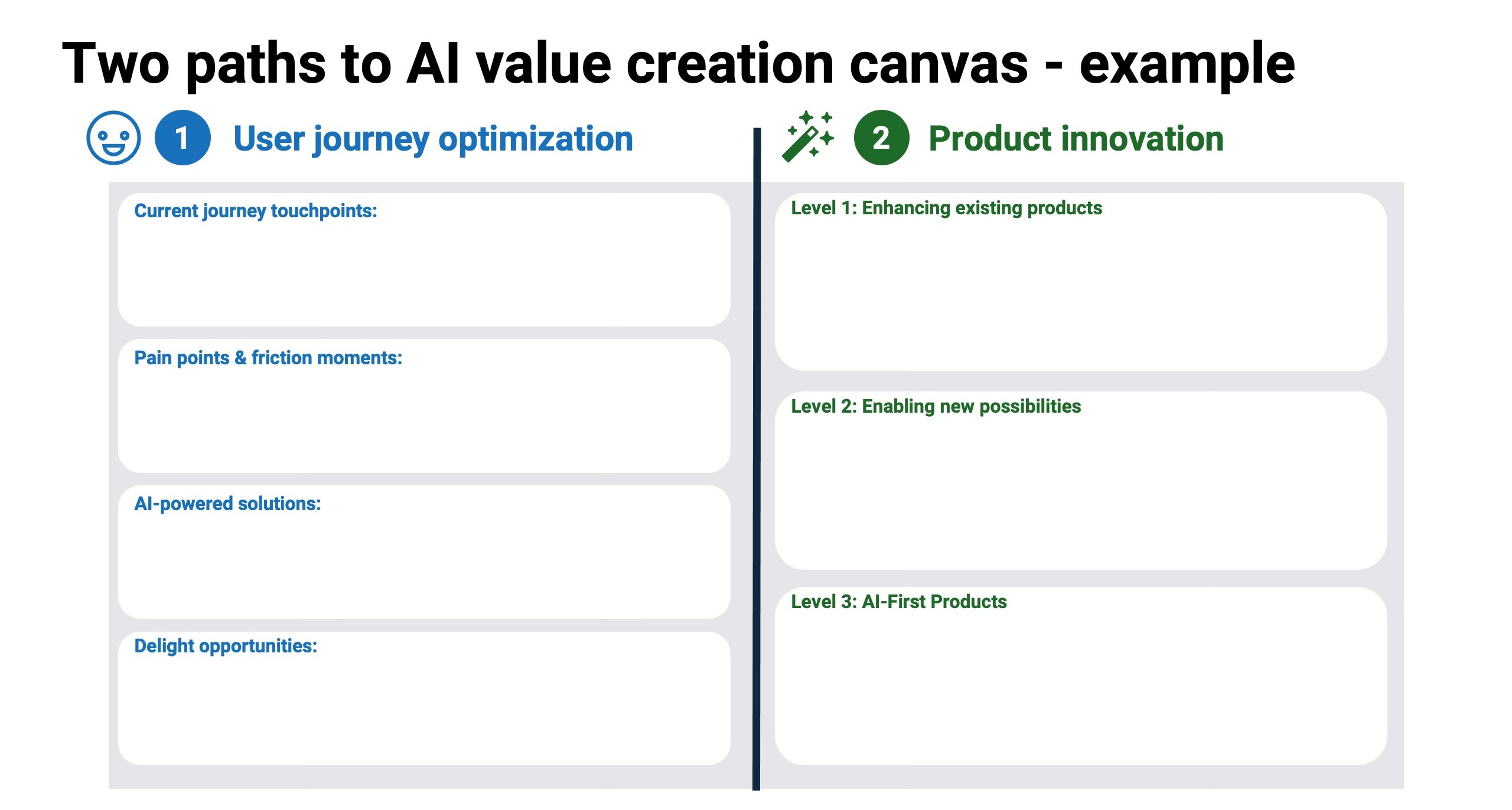
Path 1: User Journey Optimization
The first path focuses on your existing customer experience. It starts not with AI capabilities, but with your customers’ reality.
Begin by mapping your current journey touchpoints - every interaction a customer has with your product or service. For an online learning platform, this might include course discovery and browsing, registration and onboarding, learning content consumption, assessment and progress tracking, certification and completion, and technical support requests.
Next, identify pain points and friction moments. Where do customers struggle, wait, or settle for “good enough”? In that same learning platform, students might struggle to find relevant courses among 1000+ options. One-size-fits-all content pacing frustrates learners. Manual grading feedback takes 72 hours. Generic onboarding doesn’t match individual learning styles. Support tickets take 24+ hours to respond.
Now - and only now - consider AI-powered solutions that address these specific frictions. A personalized course recommendation engine based on goals and skills. Dynamic content that responds to comprehension signals. Instant AI assignment feedback and explanation. Adaptive onboarding that adjusts to preferences. An AI chatbot for immediate support resolution.
Finally, look for delight opportunities - ways AI can surprise customers with unexpected value. AI-generated study guides tailored to weak areas. Proactive career advice based on skill development patterns. Personalized celebration messages for achievements.
The key discipline: every AI solution must trace back to a specific friction point or delight opportunity. If you can’t draw that line, you’re building AI theater.
Path 2: Product Innovation
The second path is more ambitious. Instead of optimizing existing experiences, you’re adding capabilities that weren’t previously possible.
I think of this as three ascending levels:
Level 1: Enhancing existing products. These are AI features that improve what you already offer. AI-powered search with natural language queries. Auto-generated closed captions for all video content. Smart note-taking that highlights key concepts. Automated progress reminders and study scheduling. An AI teaching assistant for basic Q&A within courses.
Level 2: Enabling new possibilities. These go beyond enhancement to create experiences that weren’t feasible before AI. Virtual AI tutors that adapt teaching style to each learner. Real-time content generation based on current industry trends. AI-powered peer matching for collaborative learning. Immersive AI-generated simulations for practical skills. Predictive learning path optimization for career goals.
Level 3: AI-First Products. At this level, AI isn’t a feature - it’s the foundation. The product couldn’t exist without it. An AI learning companion that evolves with the student over years. Dynamic skill assessment through conversational AI interviews. AI-generated immersive learning worlds. A collective intelligence engine that synthesizes learning patterns across all users to generate entirely new educational content.
Choosing your path
Most organizations should pursue both paths simultaneously, but with different time horizons.
User journey optimization delivers value quickly. You’re solving known problems for existing customers. The ROI is measurable and the risks are contained. Start here to build confidence and demonstrate results.
Product innovation requires longer investment but creates differentiation. Level 1 enhancements can often be implemented alongside journey optimization. Levels 2 and 3 require more strategic commitment - and more tolerance for experimentation.
The canvas I use with clients helps visualize both paths side by side. On the left: your customer journey, mapped to frictions and AI solutions. On the right: your product innovation ladder, from enhancements through new possibilities to AI-first offerings. This dual view prevents the common mistake of pursuing ambitious AI products while ignoring friction in your core experience.
The discipline that makes it work
Whether you choose Path 1, Path 2, or both - the discipline is the same. Start with customer value, not AI capability. Every AI investment should answer a clear question: What friction does this remove, or what possibility does this enable, that customers will actually value?
The organizations winning with AI value creation aren’t those with the most sophisticated models. They’re those with the clearest understanding of where AI solves real problems for real customers.
#3 - AI Tool Spotlight: Innovation Skills repository
Claude Innovation Skills: systematizing innovation with AI
Last month I ran a workshop for Innovationsledarna - an organization dedicated to building innovation capability in Swedish organizations. The topic: how to use AI for systematic innovation.
During that workshop, something became clear to me. The participants didn’t need just another demo of AI generating ideas. They needed a structured approach - a way to ensure AI-assisted innovation followed proven methodologies rather than producing random brainstorming output.
That workshop led me to build something I’ve now open-sourced: the Claude Innovation Skills repository. It’s a collection of AI-powered skills that guide users through systematic innovation, from understanding customers to validating solutions.
What are Claude Skills?
Claude Skills are reusable instruction sets that teach Claude how to perform specific tasks in a repeatable way. Think of them as specialized expertise you can load when needed. When you upload a skill, Claude automatically activates it when relevant to your task. We covered them in more detail in issue 5.
For innovation work, this solves a persistent problem. AI is excellent at generating ideas. But ideas without structure are just noise. The real value in innovation comes from following proven methodologies - and making sure AI follows them too.
The innovation skills system
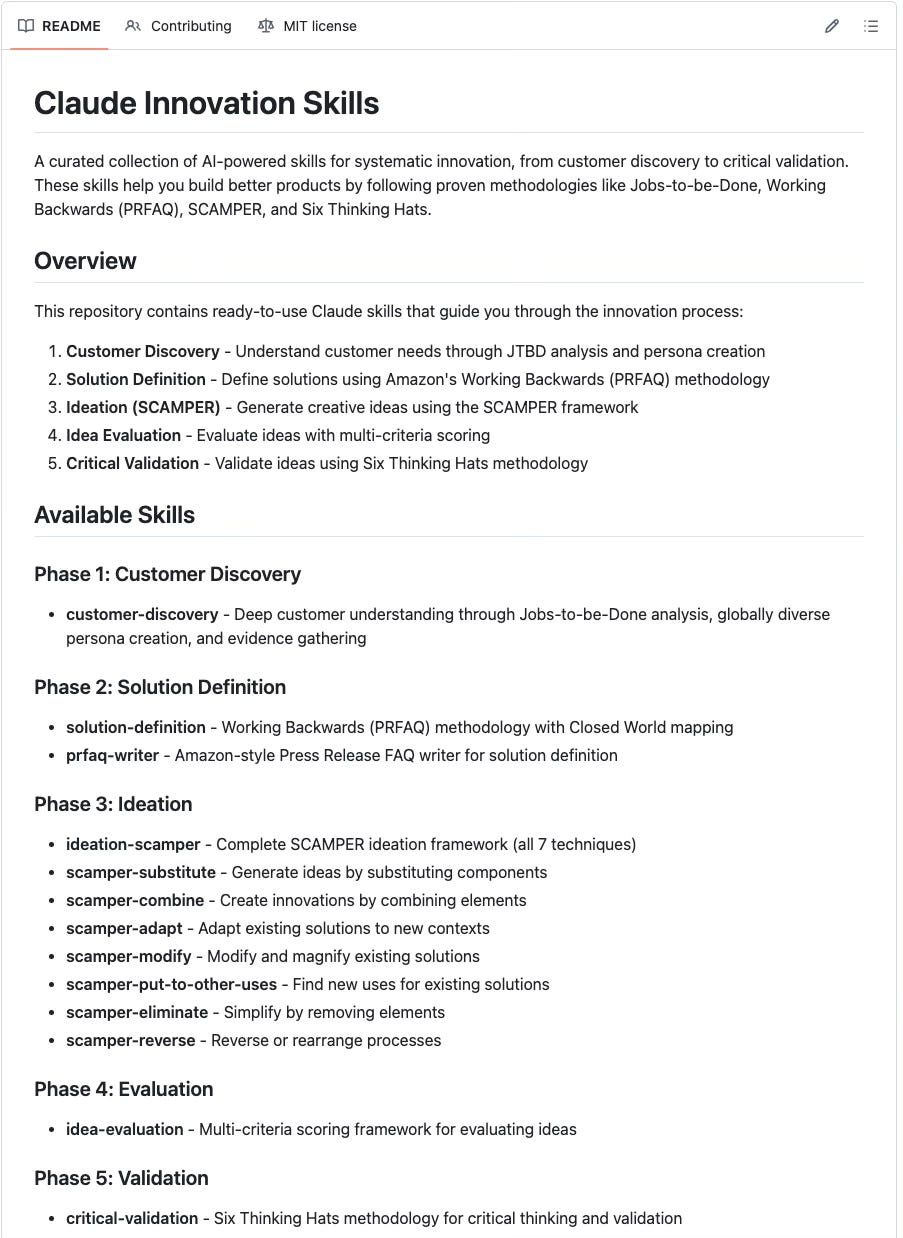
The repository contains five interconnected skills designed to work as a complete innovation process:
Customer Discovery: Start here. This skill guides you through Jobs-to-be-Done analysis, persona creation (with built-in global diversity requirements), and evidence gathering. It ensures you understand the problem before jumping to solutions.
The skill operates in two modes: interactive (step-by-step guidance with checkpoints) or autonomous (complete analysis based on your initial prompt). First-timers should use interactive mode. Experienced practitioners can try autonomous mode for faster first drafts.
Solution Definition: Once you understand the customer, this skill applies Amazon’s Working Backwards methodology. You’ll create a Press Release and FAQ (PRFAQ) that describes your solution from the customer’s perspective - written as if the product already exists and is succeeding.
The skill also incorporates the Closed World principle from Systematic Inventive Thinking: mapping what resources you already have available before seeking external additions. This combination forces clarity about both the “what” and the “how.”
Ideation with SCAMPER: Now it’s time to generate ideas - but systematically. The SCAMPER skill (and its seven modular sub-skills) guides you through Substitute, Combine, Adapt, Modify, Put to other uses, Eliminate, and Reverse/Rearrange. Each technique has its own skill file, so you can run the full framework or focus on specific techniques.
This is where AI’s volume advantage shines. You can generate 30-50+ ideas across all seven techniques in a single session - something that would take days in traditional workshops.
Idea Evaluation: Volume is worthless without selection. The evaluation skill applies multi-criteria scoring across customer value, feasibility, viability, and strategic fit. It helps you identify your top 3-5 ideas for deeper exploration.
Critical Validation: Before committing resources, the validation skill uses Edward de Bono’s Six Thinking Hats methodology. You systematically examine ideas through different lenses: facts, emotions, risks, benefits, creativity, and management/decisions. This surfaces blind spots that enthusiasm might otherwise hide.
Why this matters
The innovation methods in these skills aren’t new. Jobs-to-be-Done comes from Clayton Christensen. Working Backwards is Amazon’s methodology. SCAMPER was developed by Bob Eberle. Six Thinking Hats is Edward de Bono’s framework.
What’s new is making these methods accessible through AI. A solo founder or a small innovation team can now run a structured innovation process that previously required consultants or extensive training. A product team can generate, evaluate, and validate ideas in hours instead of weeks.
And because the skills are open-source, you can customize them. Add your industry context. Incorporate your company’s evaluation criteria. Build on the foundation to create something that fits your specific needs. With this repository, Ai can truly become your team’s innovation copilot.
Getting started
The skills work with Claude Pro, Max, Team, or Enterprise accounts with skills enabled. You can:
Download individual skill files from the repository
Upload them in Claude Settings → Capabilities → Skills
Toggle different skills on as needed
Then simply describe the task you want to do, and Claude will automatically identify and load relevant skills.
The repository includes quick reference guides, example outputs, and detailed methodology documentation for each skill. Everything you need to start systematizing your innovation practice.
Repository: github.com/thinkbigleaders/claude-innovation-skills
#4 - One New Term at a Time: Interpretability vs. Utility
This Week’s Term: Interpretability vs. Utility - the tension between demanding full understanding of how an AI system works versus accepting that a system reliably produces useful results without complete transparency into its internal reasoning.
In the AlphaFold interview below, Nobel laureate John Jumper addresses a common demand: that we should only use AI systems we can perfectly understand. His response is refreshingly pragmatic. He points to the Romans, who built remarkable bridges and aqueducts without Newton’s equations of gravity. They had intuitions, tested them, and built things that worked. Modern aircraft design works similarly - we use wind tunnels and simulations for specific geometries even though turbulence isn’t fully understood at a theoretical level.
For business leaders, this reframes a critical question. Instead of asking “Can we explain exactly how this AI reaches its conclusions?” the more productive question is often “Can we reliably measure whether this AI produces useful, accurate results for our specific use case?”
This doesn’t mean abandoning all scrutiny. Jumper emphasizes that scientists learned to use AlphaFold’s confidence measures to know when outputs were trustworthy. The key is building appropriate validation - not demanding theoretical transparency as a prerequisite for any use.
The practical implication is not to let the pursuit of perfect interpretability block adoption of tools that demonstrably work. Build measurement systems, define success criteria, validate outputs against real-world results - and accept that some effective tools will remain partially opaque. As Jumper puts it: “We don’t have to get tied up in the philosophy. We can just build useful systems.”
Think Big Newsletter is created by Think Big Leaders -