Welcome to the Think Big Newsletter, where we explore how business leaders can create value with AI and innovation. In each issue, I’ll share practical strategies, real-world case studies, and actionable frameworks that help you navigate the AI wave without getting lost in the hype.
I’d love to hear your thoughts, challenges, and suggestions for future editions.
In this issue:
Leadership Principles in the Age of AI - AI Stories
Business Value with AI - The narrative is the mechanism
AI Tool Spotlight - Decript
One New Term at a Time - AI Spring
#1 - Leadership Principles in the Age of AI
AI Stories - a Friday at SIME
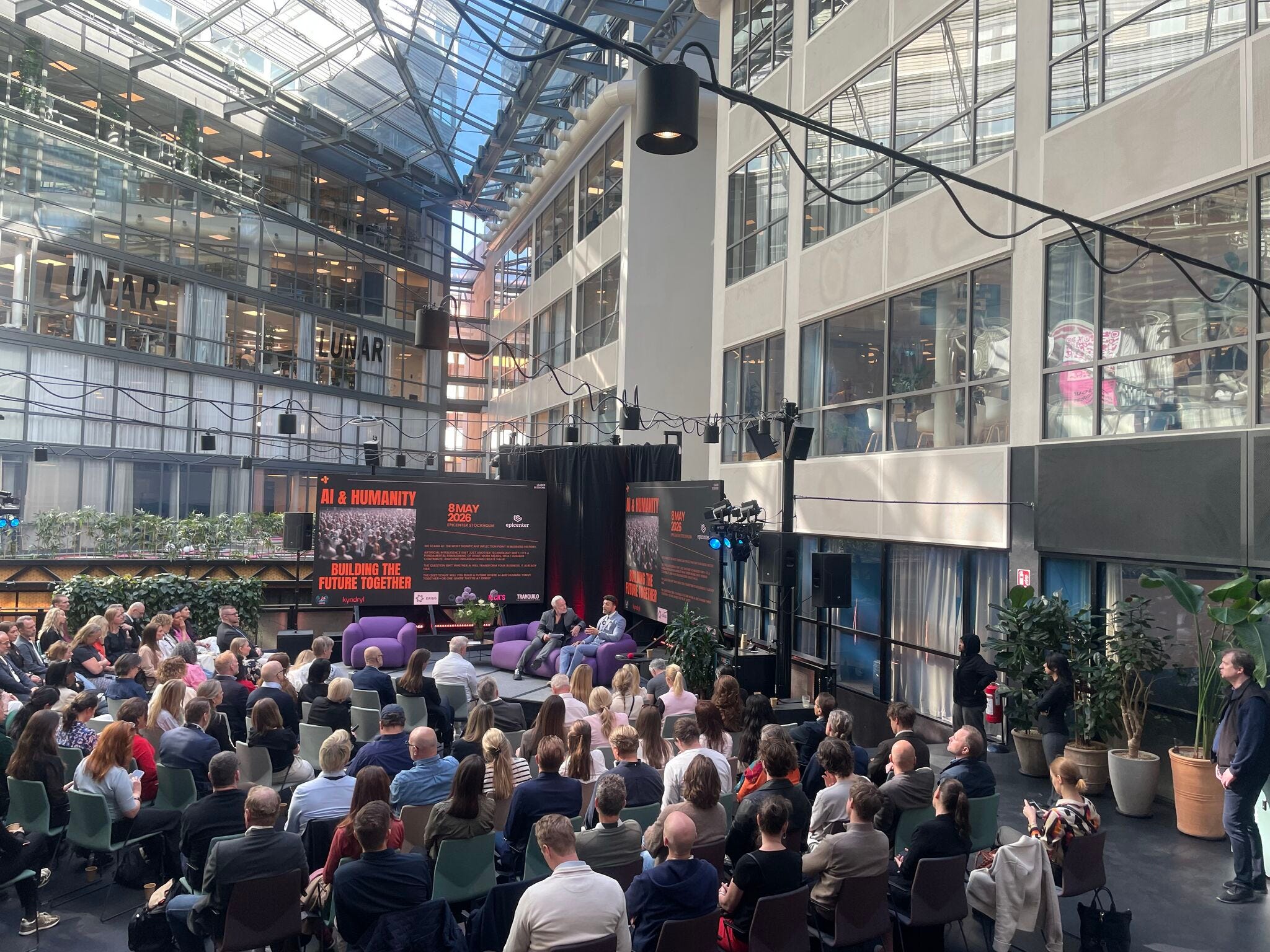
Friday in Stockholm. Epicenter is full. SIME 2026 is running under “AI & Humanity - Building the Future Together,” and I am in a room with hundreds of leaders who showed up to think big about AI in public.
What strikes me afterward is not any single talk. It is the people in the room (and in the afterparty…).
A bold direction can be written down anywhere. It only travels as far as the listener already believes bold direction is possible. Rooms like SIME shorten that distance. The European AI conversation in 2026 has its own voice now, with regulation treated as a design constraint rather than an afterthought. Stockholm other Nordic cities are emerging as anchors rather than satellites of San Francisco. That is its own story.
A printed copy of Innovate Stockholm arrived the same week with a quote from me on its pages: “Think big about innovation, be flexible and open in your approach.” And many of the people in it are there at SIME.
The clause the AI age is testing
The Amazon Leadership Principle reads: “Thinking small is a self-fulfilling prophecy. Leaders create and communicate a bold direction that inspires results. They think differently and look around corners for ways to serve customers.”
The clause the AI moment is most directly testing is the verb pair, create AND communicate. Creating bold direction has always been hard. Communicating it consistently, personally, vividly, for years across every layer of an organization has never been easy either. In 2026 it is technically easier than ever and emotionally harder than ever. AI can draft your keynote, personalize it for fourteen audiences, translate it into eleven languages, and post it across twelve platforms by lunch. Workers can also feel, and resent, when the bold direction was authored by a model rather than by you.
So what does a Think Big story actually look like in 2026?
Bold direction at scale
The canonical Think Big enactment in 2026 is Andy Jassy. This month he committed Amazon to $200B in AI capex and framed it explicitly: “You have to bet big when you find major inflection points.” Jassy’s bold direction lands at Amazon’s scale because he has been personally and consistently repeating it for years. Will this bet pay off? Time will tell.
Most European leaders cannot bet $200B. What they can do is communicate one bold direction with the same consistency, in their own voice over a decade, and use AI to amplify the reach without letting it dissolve the conviction. That is the discipline this issue is about.
Megaphone, not author
The flattening effect is mechanical. AI gravitates toward the dominant linguistic norms and the statistically common phrasing. Ayd Instone, writing earlier this year: “Emails are smoother, articles more polished. But they increasingly have started to sound the same. Not bad. Not wrong. Just curiously interchangeable.”
That is the texture your bold direction takes on when AI authors it: smooth and safe, interchangeable with every other CEO’s bold direction.
What is the counter-move? More CEOs in 2026 are deliberately publishing in their own slightly imperfect voice. The polish now reads as evasion, and the rough edge now reads as sincerity.
For the Think Big leader in 2026, the live decision is what role you let AI play. AI as megaphone takes one keynote and reaches fourteen markets with the same conviction intact. AI as author takes the same keynote and writes it for you in a safer middle voice that nobody recognises as yours.
How can you hold the paradox?
Both poles of this paradox are real. AI will keep getting better at amplifying communication, and refusing to use it is a dereliction. AI will also keep getting better at writing for you, and handing it your bold direction is a different dereliction. The leaders who navigate this will use AI more aggressively than their peers and disclose its use more openly than their peers, while still authoring the actual direction in their own voice for ten years at a time. Lean too far toward speed and scale, and your bold direction starts sounding like every other bold direction. Lean too far toward purity and craft, and you cede the room to leaders who are reaching forty markets while you reach two.
This week
One concrete experiment before next Friday. Take your most recent piece of leadership communication. Ask three questions out loud. Can I say the bold direction in one sentence in my own voice, without notes? When I read this back, does it sound like me, or does it sound like a CEO? If a friend who knows me well read it, would they recognise the writing as mine? If any answer is no, you have not lost a piece of content. You have found the work.
#2 - Business Value with AI
The narrative is the mechanism
Three independent reports last year reached the same conclusion from completely different methodologies. BCG surveyed 1,250 senior executives across nine industries and found that 5% of companies are “future-built,” generating 1.7x the revenue growth and 1.6x the EBIT margin of their peers from AI investment. McKinsey’s State of AI 2025 found that ~6% of organisations are high performers attributing 5% or more of EBIT to AI, while 88% have AI in production somewhere and 94% report not seeing significant value. MIT NANDA’s GenAI Divide study of 300 deployments concluded that 95% of GenAI pilots fail to scale, with cost overruns averaging 380% at production versus pilot projections.
Three different studies. The same number for the winners.
The standard explanation for that gap is technology, with model quality and integration fragility usually leading the list. The data says something different. RAND’s 2025 review of more than a thousand AI projects found 63% of implementation challenges stem from human factors, not technical limitations. Projects with dedicated change management succeeded at 2.9x the rate of those without. The 94-versus-6 percent gap between AI in production and AI capturing value is, before anything else, a narrative gap.
Andy Raskin’s strategic narrative framework
Andy Raskin has spent a decade helping CEOs at companies including Salesforce, Square, Uber, Gong, and Dropbox build what he calls strategic narrative: a single story the CEO uses to align marketing, sales, product, fundraising, and recruiting around one direction. His framework has five pieces.
First, name the shift: old game to new game. Salesforce told customers “software is over, the cloud is coming.” Zuora told them “transactions are over, subscriptions are coming.” Gong told them “opinions are over, reality is coming.” Each is one sentence, deliberately compact. Raskin’s discipline: concise beats complete.
Second, name the stakes. Show that the winners are already playing the new game and the losers are not. Make the future split between a clearly negative outcome and a clearly positive one. Raskin’s analogy is Star Wars: Luke refuses Obi-Wan’s call to adventure until the aunt and uncle die. Until then, the future feels okay enough.
Third, name the object of the new game. The rallying cry. Zuora: “turn customers into subscribers.” Airbnb: “live anywhere.” 360Learning: “upskill from within.” Often phrased as a question that brings the listener in as a co-adventurer.
Fourth, name the obstacles. What used to be called “problems we solve” become obstacles to a meaningful goal already positioned as life and death. Same content, different emotional weight.
Fifth, the magic gifts. Now you talk about your product. Raskin’s line: “You’re not pitching product. Your product is like a prop for making the story come true.”
What does this discipline look like in 2026, when the same CEO has AI tools that can spray ten variations of the narrative across every channel by lunchtime?
What AI does to this
Three failure modes, three named cases.
The Drift. AI personalizes the message per audience. The middle management layer is the most disengaged it has been in a decade, which is the layer where the CEO’s narrative has to land.
The Spray. AI generates infinite comms artifacts (CEO videos, Slack posts, town hall decks, customer emails) and quantity overwhelms coherence. A Stanford study found 41% of workers encounter AI-generated workslop monthly, costing about two hours of rework per instance and creating a $186 invisible tax per worker per month.
The Outsource. Sebastian Siemiatkowski at Klarna delivered Q1 2025 earnings via an AI-generated avatar of himself. By May 2025 Klarna was rehiring human customer service agents, and Siemiatkowski admitted publicly: “we went too far.” The avatar was the visible artifact of a deeper move Klarna had to walk back. Authoring had been outsourced, and the conviction drained out of it.
The cure has the same shape Raskin’s framework already has, with one AI-era addition: amplify, do not generate. Both halves of that pair matter. Refuse to amplify, and you cede the bandwidth war to leaders who are reaching forty markets while you reach two. Hand AI the authoring, and you flatten what made the bandwidth worth fighting for. Tobi Lütke’s April 2025 AI-first memo at Shopify is the cleanest 2025 example of this discipline. The memo travelled from his desk to every employee and journalist who saw it with the same sentences intact, partly because he wrote it himself and partly because nobody softened it on the way out. Whether you agree with the policy or not, the narrative did not drift. Satya Nadella is doing the same work in real time this quarter, publicly fighting the “AI slop” framing and trying to author “bicycles for the mind” as the counter-narrative in his own voice.
The diagnostic
One question to run on your own AI transformation this week. Can a frontline employee in your organization state your AI transformation thesis in your CEO’s own words within ten seconds? If yes, you are already in the 5%. If not, the work is upstream of the next AI tool you were planning to buy.
Watch Any Raskin’s episode on Lenny’s podcast to dive deeper into the strategic narrative framework.
#3 - AI Tool Spotlight: Descript
“A lot of what you do is make sure everyone knows the story.”
The story has to leave your laptop somehow. For a lot of leaders that somehow is video: keynote clips, customer messages, internal town halls, the speaker reel that lives on your homepage. Until 2024 producing any of those well meant booking a small production team and waiting three weeks. Today it can mean Descript and an evening.
That opening line is from Laura Burkhouser, CEO of Descript. She explains their stance on AI: “We like AI, but we also really like humans. We think humans are better storytellers than AI, but man, AI is so fast at doing discrete actions and we really want to build a platform that leverages the magic of that so that we can tell more stories.”
How Descript thinks about their tool
Burkhouser describes Descript in three layers.
The generation layer does the polish: Studio Sound for audio, eye-contact correction, filler-word removal, lip dubbing and jump-cut concealment, plus the smaller niceties like speaker identification and automatic captions.
The application layer is the human-in-the-loop step where you actually edit the story you wanted to tell - as Burkhouser puts it, “the last 10 to 20 to sometimes even 30%, depending on how much artistic flare you have, you’re going to need to do yourself.”
The orchestration layer is Underlord, Descript’s background AI agent. Underlord imports footage and drafts rough cuts on its own, then proposes B-roll and social clips through the API and MCP. You can watch the full interview at
My week with it
Two weeks ago I sat down with Gary Fabbri - a professional video storyteller and creative director - in a studio we rented for a series of takes. Gary combined those takes with footage I already had from previous podcasts and workshop recordings, and shaped a powerful two-minute speaker reel. We iterated, I asked for several adjustments, and he sent back two final versions. I shared them with a few friends and got back another round of small notes.
Then I opened the file in Descript. I removed some filler words I had not noticed before, and changed a couple of cuts that felt slightly off after the friends’ feedback. I let Underlord, Descript’s AI co-editor, suggest a couple of more tweaks. I reached for Overdub on two sentences where I wanted to sound a little more fluent without re-recording an entire take, and used it only on words I had actually said. Along the way Descript auto-labelled the speakers.
The whole pass took about an hour. Gary’s work was the foundation: the story shape, the pacing, the artistic decisions only a human storyteller does well. Descript was the polish I could not have justified asking him for a fourth round on (or renting the studio again). That seems to be the right division of labor for now - a human creative director sets the story, AI-assisted post-production tightens the execution, and you keep the final cut in your own hands.
You can watch th speaker video reel on my website.
Bonus angle - the company as a product
Amazon teaches its product managers to think like CEOs of the product. Burkhouser’s interview hints at the inversion: the CEO as the product manager, and the company as the product. She names her hardest discipline plainly: Namely - not to “…be a product manager. The hardest thing for me not to do is to say, I’ve got this one, I’m just going to write this back.” Opening Cursor and building it herself is fun and fulfilling. For a CEO it is also low leverage.
The CEO-as-PM job looks like what Burkhouser calls being a simplifier, pulling people out of the weeds and helping them see why the work matters, plus what her mentor told her: “The more senior you get, the more your job is walking into different rooms and saying the same three things all over again.” That is Section 2’s strategic narrative work in product-management clothes. The PRD for the company-as-product is your bold direction, said out loud, in the same words, in every room. AI is the lever that finally lets a CEO-PM ship the same three things into forty rooms with the conviction intact. Descript is one button on that lever, for the rooms that need video.
Get started with Descript
If you have raw video sitting on your hard drive and you have been telling yourself you will get around to it, Descript will collapse the gap between intent and shipped output. The free tier is enough to test the workflow. If you find yourself reaching for Underlord to write the story for you, stop. The story is the thing you own.
Watch Laura’s interview below to see things from her point of view.
#4 - One New Term at a Time: AI Spring
In December the sun sets in Stockholm at 14:45. You wake up in darkness, go to work, have lunch, look out the window, watch darkness fall. You can take your vitamin D and call it survival. Or you can do what Lara Szabo Greisman and her co-founders have been doing since 2020: light up the city for the darkest week of the year. The Nobel Week Lights festival now draws over 3.4 million visitors in five years. The City Hall facade gets photographed thousands of times in -15°C, by people taking their picture. The constraint is the canvas. The dark is what makes the light visible.
AI Spring is not a new phrase. Industry observers have used it since around 2017 to describe the post-transformer renaissance, the seasonal opposite of the historical AI Winters. Some voice warn that we are heading into a third winter.
The 2026 view from a Stockholm window says we are not in another Winter. Swedish AI startups raised nearly €1B in 2025, more than triple 2024. The country has the most unicorns per capita outside Silicon Valley. The 2026 budget includes the country’s first dedicated AI line item at SEK 479M. Enterprise adoption among Swedish companies jumped from 25% to 35% in a single year. Lovable, Legora, Sana, Tandem, Einride - the same compounding story over and over. Spring happens in places, when leaders choose to light something up.
And there is no better way to close this issue than Lara Szabo Greisman’s inspirational TEDx talk. Go out and make AI blossom and light up the world!
Think Big Newsletter is written by Amir Elion of Think Big Leaders -